
Maintaining the Teaching Standards at Citta Flow
Citta Flow classes are grounded in classical Hatha yoga practices, focusing on breath, mindful movement and relaxation. The intention is to keep the practice simple, accessible and supportive for all students.
To maintain consistency across the studio, teachers are asked to keep classes within the framework of classical yoga teachings and avoid introducing practices or concepts from other traditions.
This includes avoiding:
Sound bowls, chimes, gongs or drumming
Energy healing practices
Discussions of meridians, Taoist concepts or other non-yogic systems
Practices taken from other movement traditions
Highly mystical or esoteric language that may feel confusing or inaccessible for students
Our focus remains on:
Yoga postures (asana)
Breath practices (pranayama)
Relaxation and nervous system regulation
Clear, practical guidance that students can understand and apply
This approach helps ensure students experience a calm, grounded and consistent style of yoga, regardless of which teacher is leading the class.
Teaching Language & Class Tone Guidelines
At Citta Flow, we aim to create classes that feel welcoming, steady, and accessible for everyone. Many students come to yoga seeking movement, breath, calm, strength, and a sense of ease in their day.
For this reason, we ask teachers to use clear, simple, supportive language rather than heavily therapeutic or trauma-focused terminology unless specifically relevant and within your professional scope.
Please prioritise:
Plain, respectful language
Clear movement and breath cues
Choice offered naturally (without overexplaining)
Warmth, steadiness, and professionalism
Encouragement without intensity or pressure
A calm environment where students can participate at their own pace
Examples:
Instead of repeated references to trauma, triggers, safety, or nervous system states, simply offer practical options such as:
“You’re welcome to rest at any time.”
“Choose the version that feels right for you today.”
“Take a pause whenever needed.”
“You can keep this smaller or more supported.”
“Notice your breath.”
Our teaching style is supportive and inclusive, while remaining grounded in yoga as a movement, breath, and awareness practice. We trust students’ capacity and autonomy, and we avoid language that may feel clinical, prescriptive, or overly therapeutic in a general class setting.
Thank you for helping create a consistent experience that feels calm, capable, and welcoming.
Thank you for taking the time to read these Class Guidelines. They have been created to support consistency across our studio, while still allowing each teacher to bring their own warmth, presence and experience to class.
Our intention is to offer students a safe, welcoming and steady practice grounded in classical yoga principles. Clear guidelines help create trust for students, support the reputation of the studio, and make it easier for teachers to work within a shared vision.
Please read through with an open mind and know these guidelines are here to support you, not restrict you. We deeply value the unique qualities each teacher brings, and appreciate your care in helping uphold the experience we wish to offer our community.
Bronika Carter, Studio Owner
Guide for Gentle Hatha, Hatha Flow or General Hatha Class
60 Minute Class
1. Tune in and Intro (approximately 3 minutes)
Allow students time to arrive and settle on their mats.
This may include:
a brief grounding practice
simple breath awareness
gentle centering
This time helps students transition from their day into the practice.
2. Opening the Practice
At the beginning of class, explain briefly:
"I’d like to begin our practice with three OMs. You are very welcome to join me, or just listen in if you prefer."
Begin the practice with three OMs, followed by Namaste.
Introduce yourself briefly so students know who is teaching them “ Hi if we haven't met before, my name is xxx, and I’ll be guiding you through your practice this evening/morning”
3. Optional Pranayama
A short pranayama practice may be included where appropriate. Citta Flow’s preference would be Pranayama for morning practices at the beginning of class (after 3 x Om’s and Namaste) when mind is quiet. And for evening classes offer Pranayama before Savasana to aid with relaxation before evening rest.
Keep pranayama simple, accessible and clearly explained, particularly for newer students. Only teach if confident, trained and able to offer good instructions. Let students know it’s an invitation, and if they feel uncomfortable at any time to return to natural breath.
4. Warm-Up / Preparation (10 mins)
Begin with gentle movements to warm the body and mobilise the joints.
This may include:
simple seated movements
gentle supine warm-ups
gentle spinal movements
The aim is to gradually prepare the body for standing postures.
5. Standing and Balance Postures
(15-20 mins) General Hatha and Hatha Flow
(5-10 mins for Gentle Hatha)
Move into standing poses to build:
strength
stability
balance
Encourage students to move steadily with the breath, offering clear instructions and appropriate options.
6. Seated and Supine Postures (10 mins)
Gradually bring the practice down to the mat.
Include seated or lying postures to encourage:
stretching
gentle strengthening, and mobility
releasing tension
This part of the practice allows the body to gradually slow down and prepare for relaxation.
Inversions
Many students have the goal of being able to do a head stand or shoulder stand after attending a few yoga classes. I have found over the years of observing other students in yoga classes that most people don't have the shoulder or neck strength to do an inversion safely such as Shoulder Stand, or Head stand. If we ever offer an Intermediate Hatha Class or an Inversion Workshop this would be a more appropriate place to offer advanced inversions.
Alternative: Viparita Karani (Legs up the wall) Waterfall etc, there are many alternatives provided for Sirsasana and Sarvangasana. But an alternative nearly everyone can achieve is Viparita Karani. It can even be used as an alternative for savasana.
If students ask about a headstand or shoulder stand please let them know that a Workshop would be the best place for them to start to learn how to get in and out of an inversion safely, and we intend offering a workshop in the future if enough students are interested.
8. Final Relaxation – Savasana (8-10 mins)
For many yoga students, Savasana reigns as the dessert of their class experience. The sublime experience of relaxed stillness offers the perfect counter pose to busy lives. A good savasana can feel like you are hovering in the magical realm between sleep and wakefulness (perhaps even the first stages of Samadhi). After mobilizing, stabilizing, opening and balancing the body, savasana helps to integrate the practice, and gives the students space before moving back into the day. Savasana (and other restorative poses) allows a connection back to our inherent nature, the still and quiet place within. This precious time at the end of class helps to retain the prana moved and gathered though out the practice, providing a store house of energy which can be used when needed.
When teaching savasana, there is a beautiful vulnerability of the students lying down in front of you, eyes closed with their trust in you. It is a sacred time, where the energy of the moment encapsulates the whole group as they rest and restore together. Approximately 8-10 minutes is a good period of time for savasana in a general yoga class.
Note that savasana is not necessary for an effective yoga class. Depending on the group and the time of day and the theme of the class, you might decide to finish with pranayama or meditation instead. If you’ve led a dynamic and strong class, perhaps savasana would be ideal. If you’ve led a quiet and gentle class with many supine poses, then perhaps a seated meditation would work well. Just make sure that the students are able to sit for the 10 minutes or so that you’ve allocated for the savasana replacement. You might like to offer them a choice – to either sit for meditation or lie in savasana or lie on a bolster.
Ensure students are:
Comfortable – use bolster under the knees or spine, or a blanket under the head. Provide an eye pillow. Lying flat on the back can be uncomfortable for some people so props can assist in finding comfort.
Warm – we cool down very quickly once we are lying down, even in summer. Leave enough time in your class for students to settle into savasana. It can take some students several minutes to finally lie down and feel comfortable.
Ideas for savasana:
Silence. After a yoga class, sometimes silence is the most powerful way to close the session.
Yoga Nidra/body scan: If you have time (10 or more mins), lead the class through a yoga nidra. Otherwise, just a body scan is an effective way to consciously feel into the body and relax the major muscles and joints of the body.
Simple pranayama at the beginning of savasana (e.g. breath awareness, rising and falling of belly, feel the pauses/gap between each breath, count 10 breaths backwards, etc). Appropriate music. A soft instrumental or mantra can block out any external noise and can have a deeply calming effect, thereby enhancing the experience.
Adjustment/massage:
Some teachers like to use adjustments and assists in savasana. I generally do not; relying on verbal cues instead, as there is simply not enough time for me to get to each student and there is a tendency for the students to be ‘waiting’ for me to get to them and then they miss out on the internal process of savasana. However, in a small class, with beginners, or others who appear uncomfortable or confused, adjustments can be a welcome addition to enhance the savasana experience. For example, roll the shoulder blades under to flatten them onto the floor or give a head & neck massage.
Visualization: a walk in the park, sitting in a temple, imagine ball of light/flame/flower in the heart centre, etc.
Be careful with visualizations. Some images can conjure up memories which may not be pleasant, especially for those with past trauma. For example, water imagery may not be suitable for someone who has experienced a near drowning.
Read poetry/philosophy/quote:
Read a small passage of something meaningful and uplifting, then allow the words to sink in with silence.
“Hold the Space” – Be aware and responsible. During savasana, it is your responsibility to stay present and receptive to the energy in the room – this is holding the space. I’ve heard about teachers who play on their phone during savasana! Your energy and attention is palpable so ensure that you sit upright and be right there with the students, so they feel safe and attended to. Do not lie down yourself as it would not be helpful if you fell asleep!
Transitioning out of Savasana
At the end of Savasana, most students are deep within their experience, and you want to be careful not to startle them. Using a soft tone in your voice, say something like, “gently draw your awareness back to the body, back to the breath”. Instruct movements like wiggling fingers and toes, rolling through wrists and ankles, stretching arms overhead, etc. Have them draw the knees to the chest and roll to the side in foetal position, taking a breath or two, then return to a comfortable seat. If you choose to finish with savasana, try not to skimp on this portion of the class. Savasana is not just lying there and doing nothing. It is restorative, physically, emotionally, and spiritually. There really is so much to be learned and felt by the students, and from the teacher’s perspective, observed, during this integrative final portion of class. Take this time to let your intuition guide you, and slowly you will find more confidence in guiding your students.
Please don’t use sound bowls, chimes etc to bring students out of Savasana as it’s too abrupt and loud, and shifts the students back into daily life too fast.
Please make sure every class has a minimum of 8 mins Savasana at the end.
8. Closing the Practice
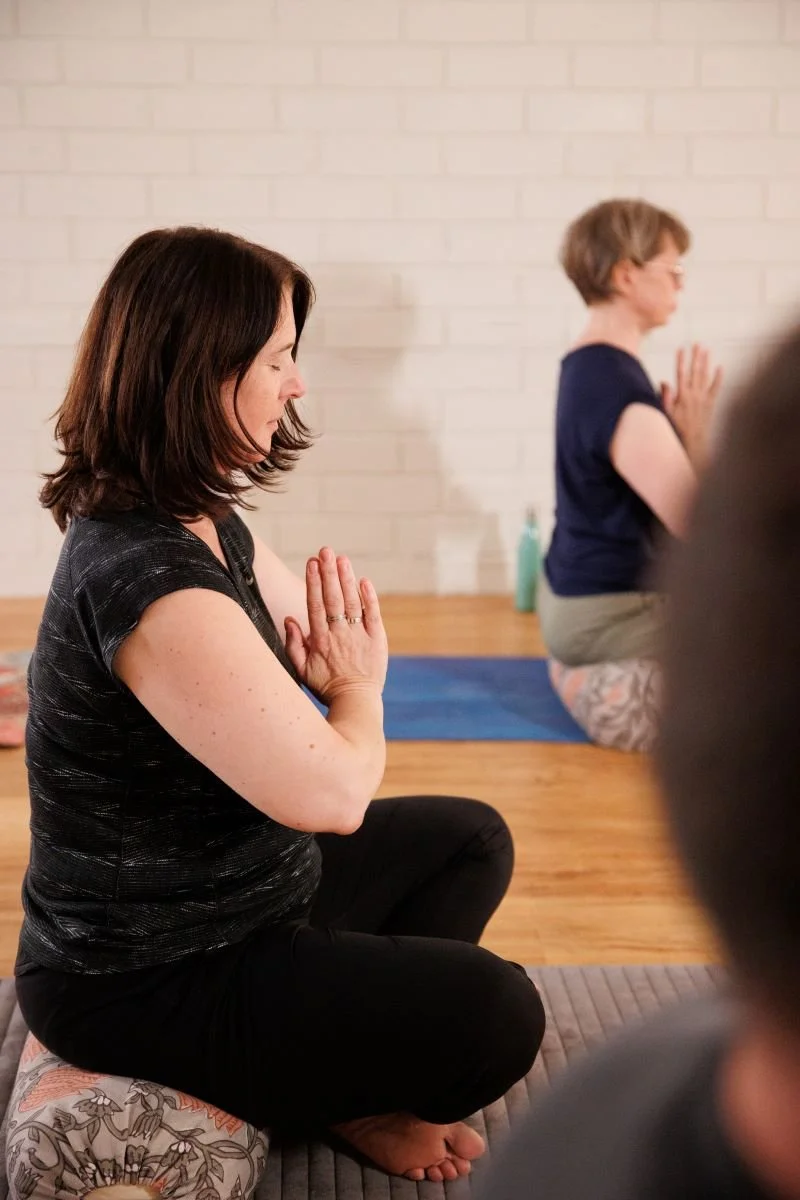
Once the students have risen from Savasana, ask them to place their hands in Anjali mudra (prayer). Finish up with your heartfelt sign off, e.g. OM or OM Shanti Shanti Shanti, words of wisdom, blessing for all beings, and then conclude with Namaste. After a few moments, you can thank the students and if you have any announcements, share those.
Sometimes the energy at the end of class can be so quiet, that announcements don’t seem appropriate, therefore, doing announcements before class begins is also an option. Don’t forget to give your own silent, personal prayer of thanks – thanks to the students, thanks to yourself and thanks to the grace that supported you as the teacher. You will find that even on your lowest days, a power is there supporting and guiding you. Acknowledging this grace will keep you humble.
Let students know you are available after class if they have any feedback or questions.
Additional Guidance for Gentle Hatha
Gentle Hatha classes follow the same overall structure, with a slower pace and additional support for students who may be:
new to yoga
recovering from injury
experiencing stiffness or reduced mobility
returning to movement after time away
Teachers should:
move at a slower pace
focus on doing less standing poses
beginner balance poses such as Tree Pose, Half Standing Wind pose ( always offer the wall as and aid for supporting balance)
offer clear step-by-step guidance
provide options and modifications
allow time between postures
The focus is on comfort, confidence and accessibility, helping students experience a positive and supportive class.
When considering the person (the students in your class), it is useful to know the stages of practice as outlined in classical yoga:
Age 8 - 24 Period of student, growing years, 100% active yoga asana.
Age 24 – 50 Period of responsibility (house holder). ½ asana, ¼ pranayama, ¼ meditation
Age 50 – 65 Period of retired life (advisor role for family) ¼ asana, ¼ pranayama, ½ meditation
Age 65 -> Last stage of life (contemplation) ¼ asana/pranayama, ¾ meditation
Mantra’s, and Yoga Philosophy
It’s okay to sprinkle a little of the above into a class occasionally, however please make sure you know your topic well, just in case a student asks for more information after class.
Please don’t over use Mantra’s that are complex, and only teach if you have the time to articulate the Sanskrit, and English translation and purpose of the mantra before asking students to chant in a short meditation for example. Nothing worse for a student than being in a class hearing some students chant every word, and feeling left out and excluded if you don't know the words or meaning.
What is Hatha Yoga? Just in case a student asks..
“Hatha Yoga” is the broad term used for any physical form of yoga. “Ha” means sun and “Tha” means moon, which represent the polar energies; yang, emanating, active, male energy vs yin, receptive, passive, female energy. The word “Hatha” comes from the Hatha Yoga Pradipika, which is a classical text describing Hatha Yoga. It is said to be the oldest surviving text on Hatha Yoga. Swami Swatmarama wrote the text in the 15th century CE, drawing upon previous texts and his own experiences. The goal of Hatha Yoga is not merely physical fitness, and includes asana, pranayama, bandhas, mudra’s and meditation.
Restorative Yoga Teacher Guide
60 Minute Class
What is Restorative Yoga?
Restorative Yoga is a deeply supportive practice designed to bring the body and mind into a state of rest, repair and recovery. Poses are fully supported with props and held comfortably for longer periods so effort can soften and the nervous system can settle.
Rather than stretching deeply or striving in postures, restorative yoga invites students to receive support, become still, breathe naturally, and release habitual tension.
Origins of Restorative Yoga
Restorative Yoga has its roots in the teachings of B.K.S. Iyengar, who pioneered the therapeutic use of props such as bolsters, blankets, belts, chairs and blocks to make yoga accessible and healing for all bodies.
His student Judith Lasater later helped popularise Restorative Yoga in the United States through her teaching and book Relax and Renew.
The intention was never “doing less yoga,” but using intelligent support so the body could rest deeply and recover.
Intention of a Restorative Class
Students should leave feeling:
calmer
softer in body
clearer in mind
more grounded
restored
Your role is less instructor, more guide and caregiver.
Teacher Mindset
Teach Less, Hold More - Use fewer poses held longer.
Comfort First - Add props quickly. If effort appears, adjust.
Voice - Slow, spacious, reassuring.
Pace -Unhurried transitions.
Room Energy - Warm, quiet, softly lit.
Props to Prepare
1 bolster
2 blankets
2 blocks
strap
eye pillow optional
Additional Information
Professional Standards for Yoga Teachers
For a full outline of official Code of Professional Conduct, please see the Yoga Australia website:
https://www.yogaaustralia.org.au/code-of-professional-conduct/ A good teacher-student relationship requires the teacher to have high standards of professional conduct. Yoga teachers need to respect the rights and dignity of all students. They also need to respect the trust placed in the teacher by the student.