
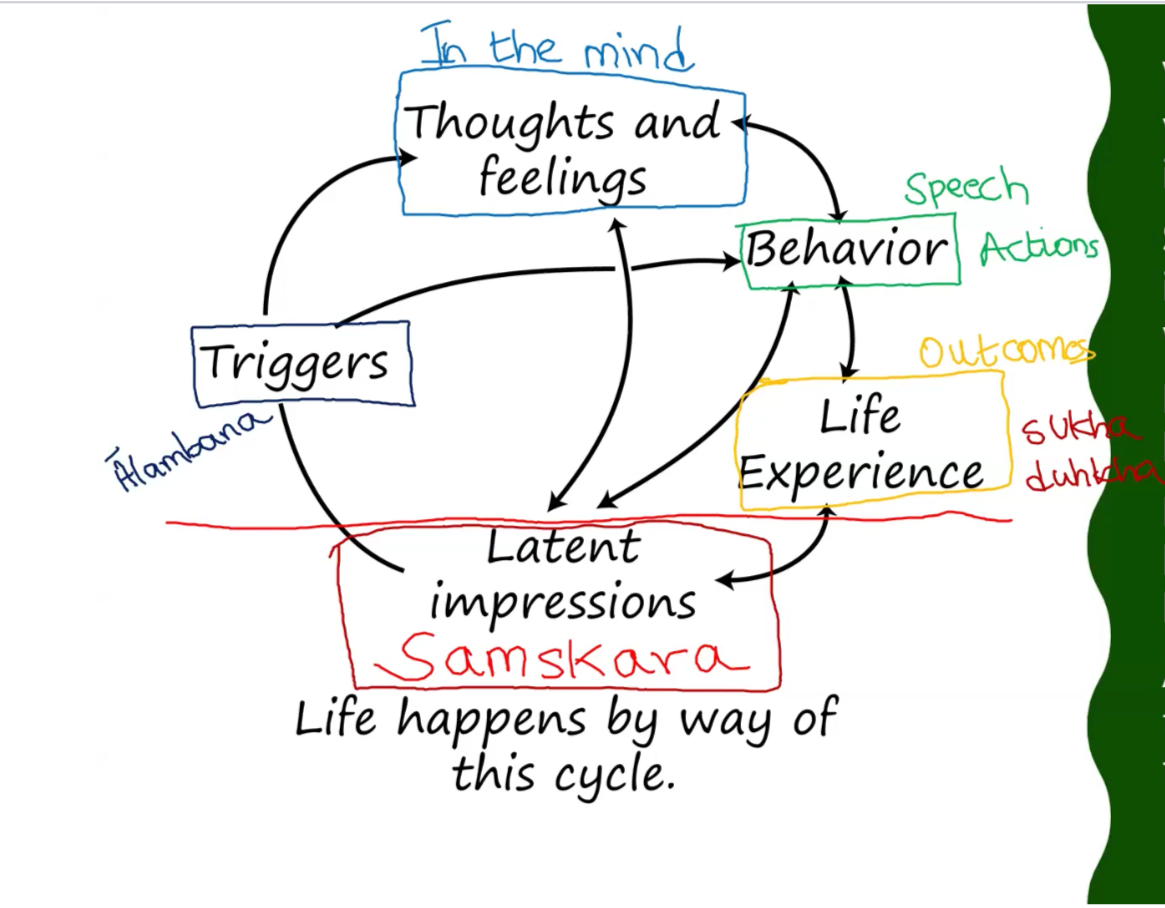
Bhava-Vritti-Samskara cycle.
Image ownership of Svasta Yoga & Ayurveda - Dr Ganesh Mohan.
We like to think we are in full control of our daily choices, reactions, and moods. But if you strip away the surface-level noise, most of us are actually running on autopilot, driven by an ancient, repeating loop.
If you have ever found yourself stuck in a cycle of overthinking, chronic stress, or low mood, you have experienced how the mind can feel like its own worst enemy.
In traditional yoga psychology, this autopilot setting is explained through a framework called the Bhava-Vritti-Samskara cycle. It is an ancient mind-body model that maps out exactly how past experiences dictate our current thoughts, and how those thoughts shape our long-term physical and mental health.
Modern psychology calls this cycle, Cognitive Behavioral Therapy (CBT). Neuroscience calls it neuroplasticity. But whatever label you use, the mechanics are identical: if you do not consciously examine the cycle, you become a victim of your own mind. The repetition of today simply repeats tomorrow.
Anatomy of the Mind-Body Loop
The cycle is a continuous feedback loop made up of three distinct phases:
Samskaras (Latent Impressions): These are the deep grooves left in the mind by past experiences, trauma, conditioning, and repetitive habits. Think of them like well-worn hiking trails in your brain.
Vrittis (Fluctuations of the Mind): Triggered by our Samskaras and external events, these are the active thoughts, mental chatter, and emotional ripples that arise. They generally fall into two categories: Sukha (pleasant) or Dukha (unpleasant).
Bhava (State of Being/Feeling): The physical attitude, emotional state, or nervous system response that results from those thoughts. This state of being then strengthens the original Samskara, burning the groove even deeper.
Without conscious awareness, this cycle runs in the background indefinitely. If an unpleasant event triggers an anxious thought (Vritti), it creates a tight, restricted state of being in the physical body (Bhava), which solidifies the brain's habit of anxiety (Samskara). The next time a minor inconvenience happens, the stress trigger fires even faster. By introducing Kindness or Calm at the Vritti (thought) stage, you completely reroute the track.
This is why catching it in the mind is such a game-changer. Noticing the Samskara in your mind, and choosing to say something like “I see this stress, I choose calm.” The moment you consciously soften your shoulders or lengthen your breath, you instantly disrupt that physical Bhava, starving the old Samskara of the fuel it needs to repeat tomorrow.
The Western Parallel: This is the exact equivalent of the psychological framework: Thoughts ➔ Feelings ➔ Actions ➔ Consequences. When left unchecked, chronic negative loops in this spectrum are precisely what contribute to long-term mental health struggles, including clinical depression and chronic anxiety.
The Law of Substitution: Starving the Stress Loop
The brilliant design of the human mind is that it cannot hold two opposing emotional states at the exact same moment. You cannot be actively compassionate and actively furious simultaneously.
Take a simple daily example: you spot an insect drowning in a swimming pool.
The Reactionary Path: If you are caught in a negative loop, you might ignore it, letting it suffer because you are rushed, frustrated, or indifferent.
The Conscious Path: You grab the pool net and fish it out. You expect absolutely nothing in return from the insect. This pure act of kindness immediately disrupts any latent anger or irritation in your system.
By actively choosing a kind, calm action, you weaken the harmful, anxious Samskaras. You are saying to yourself: "I see these stressful thoughts arise. I acknowledge them, but I do not want them to control me. I am choosing calm." Over time, the supportive thoughts literally replace the harmful ones.
Neuroplasticity: How Gentle Yoga Reshapes the Brain
For someone navigating the psychological depression spectrum, the loop can feel entirely paralyzing. The symptoms are heavy, real, and deeply physical: an inability to get out of bed, diminished interest in life, insomnia, lethargy, and a total lack of concentration.
When you are deep in that groove, you cannot simply "think" your way into a better mood. This is where the physical practice of yoga meets modern neuroscience.
Through neuroplasticity, we know the brain can structurally rewire itself based on repeated behavior and movement. If someone experiencing depression cannot get out of bed, the shift starts small, right there under the covers:
Week 1–2: Beginning with gentle movement in bed—a few mindful stretches, a gentle bridge pose, and focused, conscious breathing. This tiny physical shift changes the immediate sensory feedback the body sends to the brain, disrupting the Dukha (unpleasant) mental state.
Week 3–4: Progressing to stepping out of bed to practice a few minutes of gentle yoga on the floor, continuing to anchor the mind to the breath.
By changing the physical movement and the breath, you change the Vritti (the thoughts). By changing the thoughts, you alter the Bhava (the state of being). Slowly, bit by bit, the old, heavy pathways are starved of fuel, and new, resilient neural connections are formed.
4 Steps to Interrupt Your Autopilot Loop Using Yoga
The ultimate goal of yoga is not flexibility or physical performance; it is the gradual reduction of suffering in the mind. To stop yesterday from dictating tomorrow, you can actively intervene in the cycle using three core tools of yoga: movement, and breath, and mindfullness.
Here is how you can use them to identify your triggers and rewrite your patterns in real-time:
1.Pause and Observe (Meditation): The Moment of Trigger.
When a stressful event happens and you feel a wave of anxiety or heaviness arise, don't react immediately. Sit with the mental chatter (Vrittis). Notice the urge to repeat an old behavior, and say to yourself: "I see this thought arising. I acknowledge it, but it does not have to control me." This simple act of mindful observation is the foundation of mindfulness.
2.Shift the Physiology (Mindful Movement): 1-2 Minutes.
When your mind is stuck in a heavy or chaotic loop, your physical body locks up in tandem. Drop into your body. Drop your shoulders, unclench your jaw, or change your posture. Simple, deliberate movements—like a gentle bridge pose, a seated twist, or a neck stretch—send a neurological signal to your brain that it is safe to down-regulate the nervous system.
3.Anchor the Mind (Mindful Breathing): 3-5 Deep Breaths.
Your breath is the direct bridge between the conscious and unconscious mind. When an unpleasant state takes over, lengthen your exhalations. Long, slow, abdominal breathing stimulates the vagus nerve, turning off the fight-or-flight response. By anchoring your focus entirely on the physical sensation of the breath, you starve the negative loop of the mental energy it needs to survive.
4.The Law of Substitution (Action):Choose the Opposite.
Intentionally introduce the exact opposite emotional state through a small, practical action. If the trigger brought irritation, find a small way to express kindness or calm—even if it is just picking up a piece of litter or extending a patient word to someone. This builds a brand-new, positive pathway in the mind.
Ready to Break the Cycle?
If you are tired of being at the mercy of your own mind's automatic loops, you don't have to navigate it alone. True yoga is a systematic, practical methodology designed to give you back control over your thoughts, feelings, and well-being.
Group Yoga Classes: Join our supportive community to establish a consistent, grounding routine. Our classes emphasize classical alignment, functional anatomy, and mindful movement paired with conscious breathing to help you step off autopilot and build resilience weekly.
1:1 Yoga Therapy Sessions: If you are dealing with deep-seated patterns, chronic stress, or are navigating the psychological depression or anxiety spectrum, a personalized approach can make all the difference. In a private session, we will look directly at your unique triggers and design a tailored, gentle practice—combining movement, breath techniques, and lifestyle adjustments—to help you systematically weaken old automatic responses and rebuild your nervous system from the ground up.
Click here to view our timetable and book your first class or private yoga therapy consultation today. Got questions? email Bronika Carter, Studio Owner hello@cittaflow.com.au
