
How an ancient practice is being adapted to support modern health, and why Yoga Therapy is gaining recognition in Australia.
When most people think of yoga, they picture a group of people on yoga mats, moving through postures, stretching, perhaps doing a little meditation at the end of a class.
But there is another side to yoga that many people are less familiar with: Yoga Therapy.
Yoga Therapy takes the traditional teachings and practices of yoga and applies them in a more individualised way, with the aim of supporting a person's health, function and overall wellbeing.
Rather than following a general group class, Yoga Therapy considers the individual: their health history, current circumstances, physical abilities, lifestyle, challenges and personal goals.
It is an approach that recognises that health is about more than simply being physically fit. How we move, breathe, sleep, think, respond to stress and manage everyday life all contribute to our overall wellbeing.
And in Australia, Yoga Therapy is becoming an increasingly important part of conversations about complementary healthcare.
What exactly is Yoga Therapy?
The International Association of Yoga Therapists (IAYT), the international professional organisation supporting the development of Yoga Therapy, defines it as:
"Yoga therapy is the process of empowering individuals to progress toward improved health and well-being through the application of the teachings and practices of Yoga."
This definition is important because Yoga Therapy is not simply about performing yoga postures or being more flexible.
It is about understanding the individual and using appropriate yoga practices to support their particular needs.
A Yoga Therapist may draw on a combination of:
Adapted yoga postures and movement.
Breathing practices (pranayama).
Relaxation techniques.
Meditation and concentration.
Mindfulness and self-awareness.
Yoga philosophy and lifestyle practices.
Education and the development of sustainable daily habits.
The practices are selected and adapted according to the individual, rather than expecting everyone to follow the same sequence.
For one person, this might mean developing a gentle movement programme to support mobility and physical confidence. For another, it could involve breathing techniques and relaxation to support stress management and sleep.
The approach is individualised, progressive and designed to help people become more actively involved in their own wellbeing.
How is Yoga Therapy different from a regular yoga class?
Both traditional yoga classes and Yoga Therapy draw on the same broad tradition, but the way they are delivered is different.
In a regular group yoga class, the teacher generally offers a sequence of movements, breathing practices and relaxation that the group follows, with adaptations where needed.
Yoga Therapy takes a more individual approach.
It begins by understanding the person, their health history, current abilities and what they would like to work towards.
A personalised practice is then developed, taking into account their circumstances, needs and any relevant health considerations.
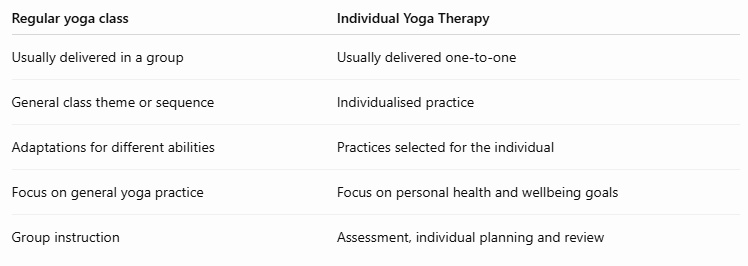
Neither approach is better than the other. They serve different purposes, and both can have a valuable place in someone's wellbeing routine.
What can Yoga Therapy support?
Yoga Therapy is used as a complementary approach to supporting people with a wide range of health and wellbeing needs.
Depending on the person's circumstances, appropriate yoga practices may help support:
Movement and physical function
Mobility and joint movement.
Flexibility and muscular strength.
Balance and coordination.
Postural awareness.
Confidence with everyday movement.
Breathing and relaxation
Greater awareness of breathing patterns.
Learning techniques to regulate breathing.
Relaxation and stress management.
Developing skills to settle the nervous system.
Mental and emotional wellbeing
Self-awareness.
Managing everyday stress.
Developing concentration.
Supporting relaxation and emotional regulation.
Building sustainable wellbeing habits.
Healthy ageing
Maintaining mobility and physical confidence.
Supporting balance and coordination.
Maintaining strength and independence.
Developing confidence in everyday activities.
Yoga Therapy is not a replacement for medical treatment, physiotherapy or psychological care. It can be used alongside appropriate healthcare, with the individual's healthcare team involved where necessary.
What does the science say?
Yoga is increasingly being studied in health research, including its potential role in supporting physical and psychological wellbeing.
Research has explored yoga in areas such as chronic lower back pain, stress, anxiety, sleep, mobility and general quality of life.
However, the evidence varies depending on the condition, the type of yoga used, the research design and the people involved.
It is important to distinguish between evidence supporting yoga as a practice and evidence supporting a particular individualised Yoga Therapy programme. They are related, but they are not interchangeable.
The Australian Government commissioned the National Health and Medical Research Council (NHMRC) to undertake evidence evaluations as part of its Natural Therapies Review 2024.
This review examined published research into 16 natural therapies, including yoga.
It was an important part of the Government's consideration of whether these therapies should again be eligible for private health insurance benefits.
It is a sign of growing interest in examining complementary therapies through a more evidence-informed approach, rather than an endorsement of every yoga intervention or therapeutic claim.
What is happening with Yoga Therapy in Australia?
There have been some significant developments.
1. Yoga has returned to the private health insurance conversation
In 2019, yoga was among 16 natural therapies excluded from private health insurance rebates.
Following the Australian Government's Natural Therapies Review, yoga was reinstated as an eligible natural therapy from 1 July 2025.
This means private health insurers can now choose to provide benefits for eligible yoga services under their policies.
It is important to understand that this does not mean every health fund covers yoga or that every yoga class automatically attracts a rebate.
Coverage depends on the insurer, the policy, the type of service and the provider's eligibility.
Yoga Australia has been working with private health insurers to establish a professional provider recognition and claims pathway for appropriately qualified yoga professionals.
This is an important step in the development of Yoga Therapy as a more clearly defined professional service in Australia.
2. Yoga Australia is strengthening professional education standards
Yoga Australia has been developing and updating its Yoga Therapy education standards to reflect the level of knowledge, training and supervised experience expected of a Yoga Therapist.
Its updated framework includes:
A minimum 350-hour yoga teacher training qualification.
At least two years of regular yoga teaching experience.
A minimum of 650 additional hours of Yoga Therapy education over at least two years.
Biomedical and psychological foundations.
Understanding of health conditions and the yogic perspective on health.
Therapeutic skills and individualised practice development.
A supervised practicum, including a minimum of 150 hours.
This demonstrates that Yoga Therapy is a specialist area of study beyond general yoga teacher training.
The distinction matters. A yoga teacher and a Yoga Therapist do not have the same training or professional scope.
3. International professional standards are developing
The International Association of Yoga Therapists (IAYT) works internationally to establish educational standards, professional ethics and a recognised framework for Yoga Therapy.
Its C-IAYT credential is awarded to eligible graduates of IAYT-accredited Yoga Therapy training programmes, or applicants who qualify through its portfolio review pathway.
One such programme is the Svastha Yoga Therapy programme, developed by A.G. Mohan and Indra Mohan, and taught with their son, Dr Ganesh Mohan.
The comprehensive 800-hour programme is IAYT-accredited and combines traditional yoga teachings with contemporary knowledge of health and wellbeing.
These developments are helping to establish a clearer distinction between general yoga instruction and specialist Yoga Therapy education.
Does Yoga Therapy come under Medicare or the Therapeutic Goods Administration?
This is an area where it is important to understand the different roles of Australian health authorities.
Medicare: Yoga Therapy is not currently listed as a standalone Medicare-rebatable allied health profession. Medicare rebates for allied health services are available to practitioners who meet specific qualification, registration and provider-number requirements.
The Therapeutic Goods Administration (TGA): The TGA regulates therapeutic goods, such as medicines and medical devices. It does not regulate healthcare professionals or clinical practice. Yoga Therapy is therefore not a TGA-registered profession.
Professional associations: Organisations such as Yoga Australia and IAYT provide professional education standards, registration or certification pathways, codes of ethics and guidance on professional scope.
Yoga Therapy is not currently a nationally registered health profession under AHPRA in the way physiotherapy, occupational therapy and psychology are.
This makes professional training, appropriate insurance, ethical practice and clear communication particularly important.
What happens during an individual Yoga Therapy consultation?
A Yoga Therapy consultation is different from simply attending a yoga class.
It starts with a conversation to understand the individual.
Depending on the person's needs, this may include discussing:
Health and medical history.
Current physical activity and movement.
Mobility, strength and balance.
Breathing patterns.
Sleep and energy levels.
Stress and daily routines.
Personal health and wellbeing goals.
From there, suitable practices can be explored and developed.
These might include gentle movement, adapted postures, breathing techniques, relaxation and meditation.
The aim is to develop a manageable personal practice that can be incorporated into everyday life.
Progress can then be reviewed and the practice adapted as the person's needs change.
It is not about pushing the body into more challenging postures. It is about finding appropriate ways to use yoga to support the individual.
Who might benefit from exploring Yoga Therapy?
Yoga Therapy may be worth exploring if you:
Want a more personalised approach than a general group yoga class.
Are returning to movement after a period of inactivity.
Want to improve mobility, balance and physical confidence.
Find it difficult to manage everyday stress.
Would like to develop better breathing and relaxation habits.
Are looking for ways to support healthy ageing.
Have particular health or wellbeing goals that require an adapted yoga practice.
You do not need to be flexible, strong or experienced in yoga to begin.
In fact, individualised yoga practice can be particularly useful for people who feel that traditional group classes are not quite right for them.
My own journey towards Yoga Therapy
At Citta Flow Yoga, I believe yoga should be accessible, practical and relevant to everyday life.
My approach to teaching is rooted in classical Hatha Yoga, drawing on the traditional teachings of yoga while recognising the importance of contemporary knowledge of the human body and health.
Having completed my 350-hour Yoga Australia-accredited yoga teacher training, I wanted to deepen my understanding of how yoga could be applied beyond the general group class.
This led me to further study in Svastha Yoga Therapy, under the guidance of Dr Ganesh Mohan.
Dr Ganesh Mohan is a medical doctor and Yoga Therapist, and a teacher in the Svastha Yoga and Ayurveda tradition. His work brings together the teachings of classical yoga with contemporary medical knowledge and a holistic understanding of health.
I am working towards the internationally recognised IAYT Yoga Therapy pathway through this further study.
It is an ongoing journey of learning, developing practical skills and deepening my understanding of how yoga can be adapted to support individual health and wellbeing.
I believe that the future of yoga lies not only in teaching people how to practise postures, but also in helping them understand how yoga can become a meaningful part of looking after their health throughout their lives.
Exploring Yoga Therapy at Citta Flow Yoga
At Citta Flow Yoga in Kalamunda, I offer individualised yoga consultations for people who would like to explore how yoga may support their movement, mobility, balance, breathing and general wellbeing.
The starting point is a conversation about you: your health history, your current circumstances and what you would like to work towards.
From there, we can explore appropriate yoga practices and develop a personal approach that fits into your everyday life.
You do not need to have previous yoga experience.
If you are curious about how an individualised yoga practice could support your wellbeing, I'd love to hear from you.
Citta Flow Yoga | Kalamunda, Perth Hills
Move well. Breathe well. Live well.
Important: Yoga Therapy is a complementary wellbeing approach and does not replace medical advice, diagnosis or treatment. Please continue to work with your GP and other registered healthcare professionals for medical concerns.
Further reading and professional information:
